OVERVIEW
WHAT THIS ARTICLE IS ABOUT
Wherever a railway vehicle passes from an insulated track section to a grounded one – in depots, automatic train wash facilities, maintenance workshops, industrial sidings or stabling yards – an electric arc with temperatures of thousands of °C is generated. It silently damages wheels, rails, and axle bearings. Annual losses at a single facility can reach millions of CZK. SALTEK offers a patented solution with a response time below 1 ms.
0.5
V
Threshold for electrical damage to a bearing
6,500
°C
Arc temperature at an insulated joint
220
k
Bearings reconditioned annually by SKF
<1
ms
SALTEK BVL-ET system response time
PROBLEM
WHERE DANGEROUS TRANSITIONS OCCUR
A metro train returns from operation to the depot. It passes over an insulated rail joint. Within a fraction of a second, an electric arc passes through the wheels and bearings, locally melting the metal. This occurs on every entry—hundreds of times per year.
On the main line, rails act as the return conductor for traction current (750 V DC for metro, 600 V DC for tram systems) and are insulated from earth. In depots and maintenance areas, rails must be directly grounded for personnel safety. The ČSN EN 50122-2 standard requires separation of these two systems by means of an insulated rail joint (IRJ)—and this is exactly where the destructive arc occurs.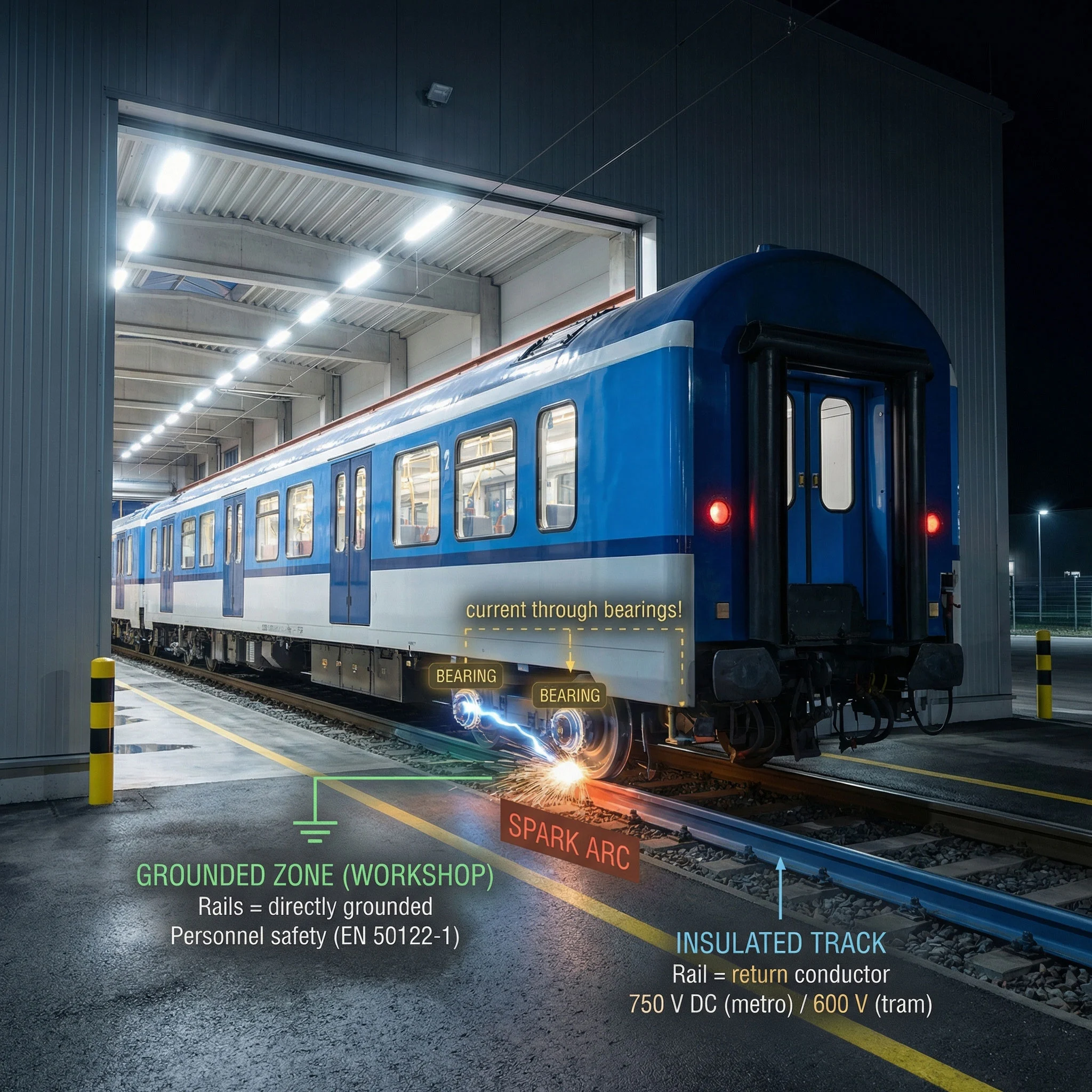
MAINTENANCE WORKSHOPS
Facilities for heavy maintenance. Rails grounded.INDUSTRIAL SIDINGS
Transition between electrified and grounded track.AUTOMATIC WASHING PLANTS
Water + grounded rails = aggressive environment.STABLING YARDS
Rails grounded for maintenance access.DEPOTS
Hundreds of IRJ crossings per year.DAMAGE
WHAT SPARK EROSION ACTUALLY DESTROYS
The spark erosion phenomenon simultaneously affects three critical components. Scientific research has revealed alarming findings.
RAILS
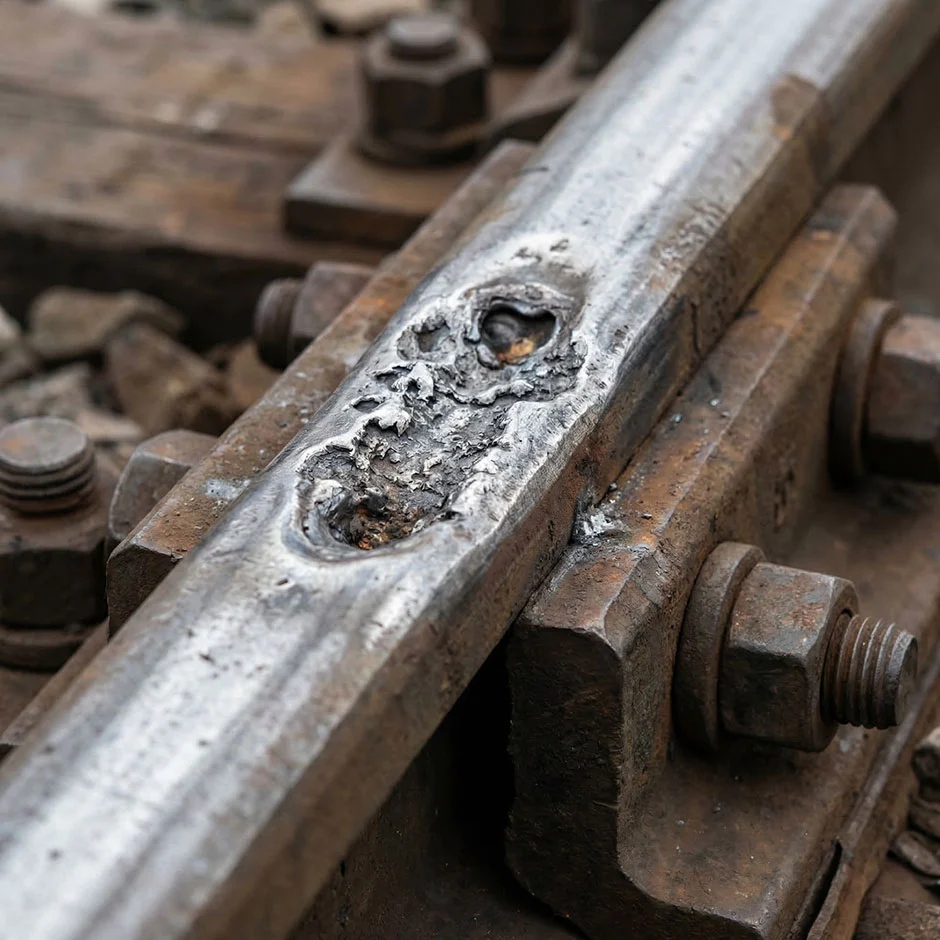
Rail head cratering
An arc with temperature from 4,000 to 6,500 °C creates craters on the approach side of the IRJ. This leads to dynamic impacts and joint failures.
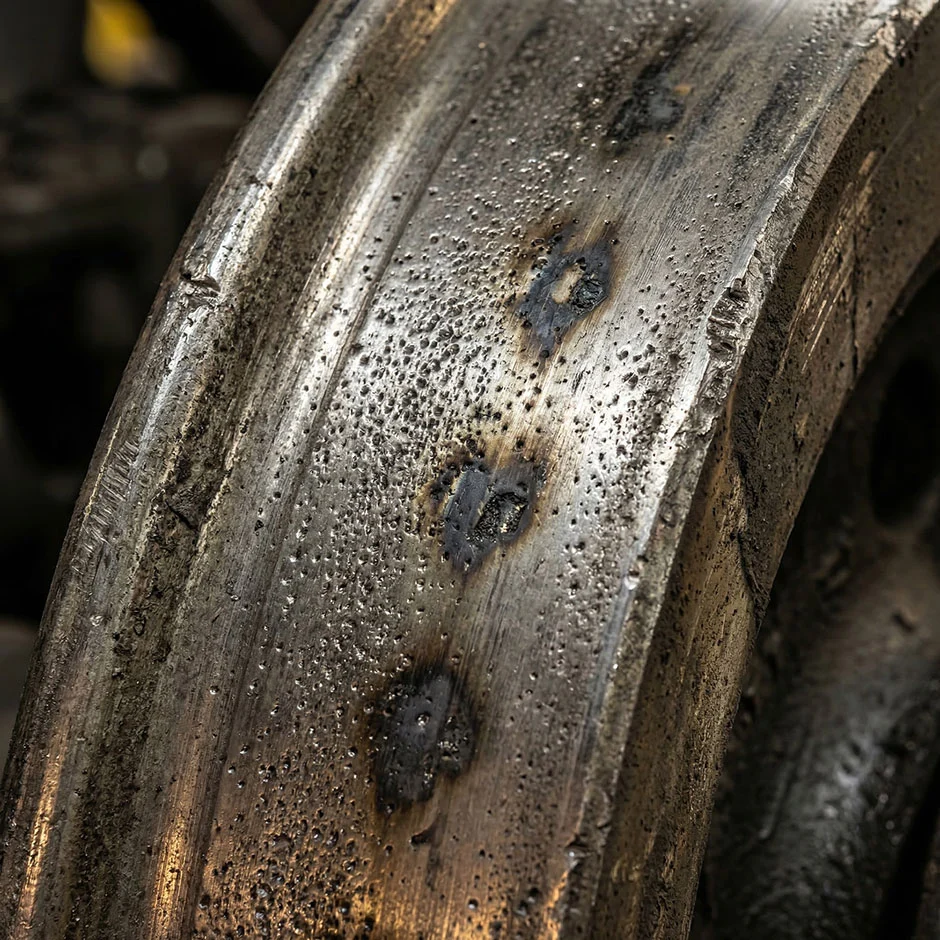
WHEELS
Tread surface damage
Microcraters → uneven wear → vibrations → premature reprofiling.
"The most expensive consumable component."
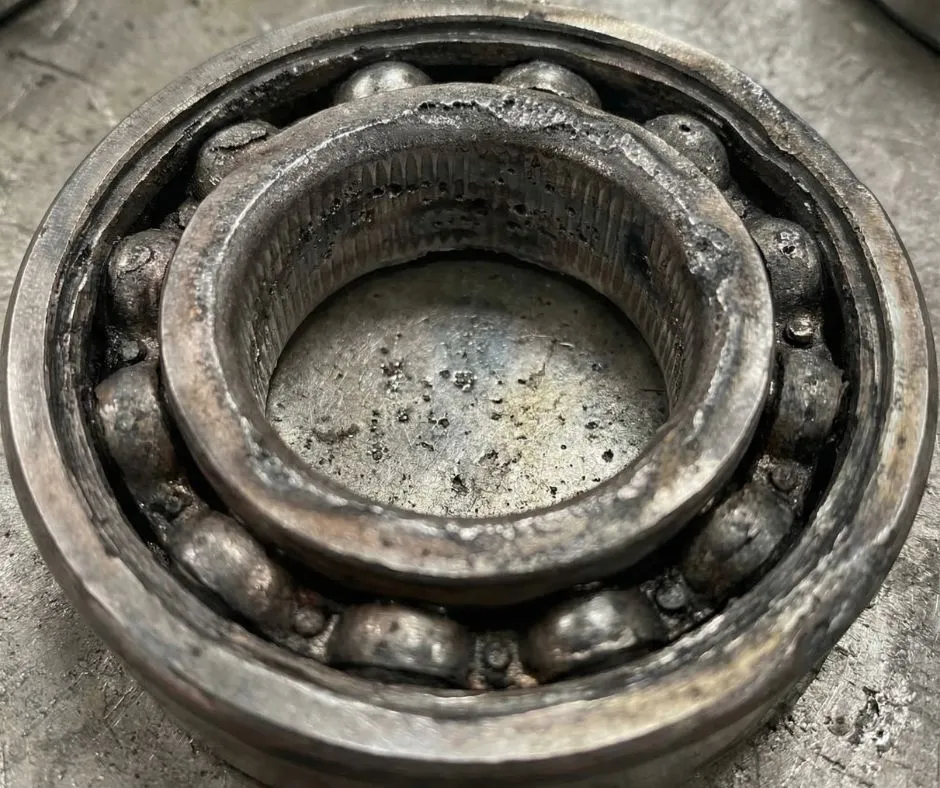
BEARINGS
Electrical erosion and fluting
Craters 5–8 μm, washboard pattern, lubricant degradation. Service life reduced to 1–20 % of L10.
PROGRESSION
THREE STAGES OF BEARING DESTRUCTION
1
MICRO-CRATERS
Invisible to the naked eye. EDM discharges create 5–8 μm craters with a rehardened brittle layer. Lubricant turns black.2
FLUTING
Parallel grooves (washboard pattern) caused by rolling element resonance. Increasing vibration and noise.3
TOTAL FAILURE
Pitting, spalling, white etching cracks (WEC). Service life reduced to 1–20 % of L10. WEC can develop in <50 operating hours.CRITICAL THREAT
WHITE ETCHING CRACKS (WEC) – THE MOST INSIDIOUS THREAT
Electrical discharges, even at current densities below 1 mA/mm², generate subsurface cracks with altered microstructure.
They are not detectable by standard diagnostic methods → sudden catastrophic failure.
Responsible for approximately 60% of bearing failures in electrical machines, including locomotives.
~60%
of bearing failures
in electrical machines caused by WEC
FINANCIAL IMPACT
THE COST OF DOING NOTHING
25
billion EUR/year
Railway maintenance in Europe
75%
of costs
Freight wagon wheelset maintenance
9 kg
of Fe/year
Iron dissolved by 1 A of stray DC current
2.4
billion EUR
Annual railway corrosion losses in China
CASE STUDY
MEASUREMENTS FROM A PRAGUE METRO AUTOMATIC WASHING PLANT
Without protection
DESTRUCTIVE
High energy discharge. Conventional protection elements do not respond in time.
With BVL-ET — Response
<1 MS
Energy limited below the destructive threshold.
Threshold voltage
~20 V
Activation well below the destructive level of 80+ V.
After installation
0 DAMAGE
No new damage to bearings or wheels.
SOLUTION
INTELLIGENT VLD WITH EXTERNAL ACTIVATION
SALTEK BVL-100-020-R02-ET
Intelligent Voltage Limiting Device (Class 2.2 VLD) with External Activation. Proven BVL series with patented external activation. Designed for critical interfaces in workshops, industrial sidings, and washing plants. Two anti-parallel thyristors + varistor – fully passive, no external power supply.
1
REMOTE ACTIVATION
SCADA/PLC sends a signal to BVL-ET before vehicle entry. The VLD electrically connects the two sections in advance.→
2
SAFE BYPASS
Current flows through properly rated semiconductor elements of the BVL-ET rated for up to 30 kA.→
3
AUTONOMOUS PROTECTION
Varistor: 25 ns. Thyristor: <1.5 ms. Operates even without an external signal.SPECIFICATIONS
TECHNICAL PARAMETERS
| Parameter | Value | Note |
|---|---|---|
| VLD class | 2.2 (VLD-O+F) | According to EN 50526-2 ed. 2 |
| Rated current Ir (60 min) | 100 A | Continuous stray current conduction |
| Short-term current Iw (30 ms) | up to 30 kA | Handles short-circuit conditions |
| Trigger voltage UTn | 20 V | Optimised for grounding transitions |
| Lightning impulse (8/20 μs) | 100 kA | Integrated Class A2 surge arrester |
| Varistor / thyristor response | 25 ns / <1.5 ms | Dual response speed |
| External Activation (EA) | Yes – SCADA/PLC | Patented feature |
| Operating temperature | –40 to +70 °C | Indoor and outdoor environment |
| Protection / Weight | IP67 / 2.9 kg | Water-resistant, lightweight |
EN 50122-1:2022
EN 50122-2:2022
EN 50526-2 ed. 2
EN 50526-3
EN 50162
ISO 15243:2017
THE DIFFERENCE IS CLEAR
✕ WITHOUT PROTECTION
✕
Rail corrosion at IRJs, dynamic impacts
✕
Wheel tread damage – premature reprofiling
✕
Bearing damage – fluting, WEC. Service life reduced to 1–20 % of L10
✕
Lubricant degradation due to extreme discharge temperatures
✕
Annual losses in the millions of CZK per facility
✓ WITH SALTEK BVL-ET
✓
Current flows through properly rated VLD semiconductor elements
✓
The response time of 25 ns to 1.5 ms eliminates arcing immediately
✓
Extended service life of wheels and bearings by tens of percent
✓
Reduction of stray currents and corrosion
✓
ROI achieved within months
Source: SALTEK – original manufacturer article
This article is based on the manufacturer’s original technical article.